Showing posts with label Teaching. Show all posts

Friday, December 21, 2012

Musicians' Perspective: Week 3, Day 5

We started today by performing and doing a Q&A for Jay's Music Appreciation class. We got into some pretty "big" topics when one of the students asked if we imagine and picture what we are trying to communicate when we play. She explained that we she dances (she was a dance student) she has a clear image of what she is dancing about. We agreed and used this as a way to point out similarities between all art forms, and encouraged the students to collaborate with their peers in other disciplines in such a diverse artistic environment like PHSA.

We taught our masterclass today on performance anxiety and performance techniques. We heard a couple more performers before teaching another 3 hours of private lessons. One of Midori's lessons included one with a singer, and the lesson went really well. She introduced the concept of "support" to the singer, a technique used by wind players and singers where the abdominal muscles are engaged to support the air stream. After a discussion on support, the singer produced a completely different, full and beautiful sound. The student explained that she was imagining singing in a big concert hall and trying to sing so clearly that the people in the very back row could hear. Midori was thrilled and praised the student for such a drastic improvement.

That evening, the dancers went to meet with former first lady Imelda R. Marcos, while we (Brian and Midori) stayed behind to sit in on a mock-competition for the pianist, Matthew. He played fantastically, and we only had a few comments. We were confident that he would do well in the competition, and as it turns out, he ended up getting second place!

After Matthew was done performing, Brian taught an extra lesson to Drew, the only clarinet player at PHSA. He had a great time focusing on one of his favorite pieces for clarinet: the Debussy Premiere Rhapsody. By tweaking just a couple of things in Drew's playing, he was able to get Drew to play with much more projection and control. Drew and Matthew were just two of the extraordinarily talented students we heard during our time there, and we are excited to see where their talent takes them in the next several years! During Drew's lesson, Midori was able to spend some quality time with the other students, getting to know them outside of the classroom.

Wednesday, December 19, 2012

Musicians' Perspective: Week 3, Day 4

We started out today with a meeting at the University of the Philippines Los Baños to discuss the day-long workshop and concert collectively titled, "Pasalubong," which comes from the root word "salubong" which means "to welcome" or "to meet." Unfortunately, the music director was unavailable for the meeting, but it was still great to see the campus and to start planning the workshop.


We taught a goal-setting masterclass, which we thought was important for the first day, since both we both agree that setting goals and knowing what you are aiming for is usually step one in becoming better at…well pretty much anything! We discussed having long-term as well as short-term, weekly, and daily goals, and to make sure they are WRITTEN DOWN. We were able to hear one of the students, Matthew, who was preparing to compete in the Thailand Mozart International Piano Competition the following week. At that point we split up, and both taught several half-hour lessons that the students signed up for. We both had really good first days of teaching. We both agreed that the most challenging part of these two weeks was trying to teach lessons to those who played different instruments than us, since most of the students at PHSA are voice, violin, piano, or guitar players. However, this was also the part of the trip that taught us the most about our OWN musicianship.

That evening, we were able to go back to Los Baños and meet with Angel, the music director at UPLB. We discussed what we wanted to collaborate on, and learned about the UPLB "Rondalla," an ensemble of Philippine folk instruments called bandurrias, along with violins, guitars, and double basses. In the end, we hoped to learn some traditional Filipino music, and also share with them some kind of American music. At the time we thought a jazz piece might be interesting, but what we ended up doing was a lot cooler.

After our meeting, Brian had to do a furious search for internet in order to make an online phone call to the US for a job interview! He finally found a place thanks to the help of our friend Reg. Once that was out of the way, we all went to Chow King, which is basically like a Burger King that serves Chinese food. They had REALLY good Halo Halo, which literally translates to "Mix Mix," understandably so, as Halo Halo is a mixture of shaved ice, evaporated milk, and some combination of fruits, jellies, beans, and is often served with ice cream. VERY delicious and VERY refreshing. Almost every Asian country has its own version of Halo Halo. In fact, we had recently had a Malasian version in New York, but we liked the Filipino version better. We had a really great time hanging out with Angel, Reg, and the other professors from UPLB.


Monday, December 17, 2012

Musicians' Perspective: Week 3, Day 2


We started the day filling out evaluations of our FIRST two weeks. These evaluations will be used to improve the project for future trips, to give us something to show to grantmakers (both past and future), and also to help write these blog posts! We met with Jay Gomez, the music coordinator, someone who we would become good friends with in the following weeks.

After lunch, we got to finally meet the music students! Since this week was basically the first week of the school year, they were all attending their first theory classes, but the theory teacher was kind enough to let us sit in to hear the freshmen perform. We already began formulating what we wanted to teach about and emphasize in our lessons and masterclasses. The students all seemed shy at first, but once we were out of the classroom waiting for the bus, they opened up and began asking us questions about ourselves, and about music in general. It was a lot of fun.

Saturday, December 8, 2012

The State of the Arts

By Leonides Arpon

My trip to the Philippines served as another awakening to the harsh reality of how the true value and importance of the arts is hardly nurtured in people’s daily lives, if at all. It makes this even more difficult when Filipino companies, theatres and touring groups struggle to compete along mainstream entertainment and moreso struggle to survive within their own performing arts community. To me it would be financial suicide to be a working artist in Manila, but when I look at the expenses of living in New York City, dancers do not make much profit, either, and usually need other jobs that really provide for their needs. However, the dollar, at least for now, can get one across the globe to audition, study and become immersed in other cultures and art forms, while earning pesos does not get one far from the archipelago and doing so is still a huge dream, even for the most talented artists within the performing arts in the Philippines.

I’ve heard that many artists in Manila stopped pursuing their careers, not necessarily because of financial difficulty but because of the direction many institutions or companies are going towards, where more pizzazz and flash are presented as opposed to in-depth research, experimentation and collaboration in a creative process. I understand how it can be a smart financial move for choreographers in NY to start doing more Broadway, operas or commercial work to earn a living and keep their dance companies alive. What happens in the long run, though, is that the company members suffer and loose interest because there is no mentorship and even when the choreographers are present the work created is “Fast Food,” Fried and served as fast as possible because of a deadline. No kneading, mashing, boiling, baking or marinating the “meat” overnight involved. Dance schools/institutes now also focus on creating followers, puppets or technicians rather than artists and leaders. These dancers then all look the same and end up quite confused as to what their individual voice or mission is when they are thrown into the real world after they graduate. These young artists spend $1000’s to learn how to live in a dance world that no longer exists today. Most of the companies or choreographers these youth in school dream of working with are either dead, struggling to survive or won’t be in existence by the time that they graduate. What easily happens next is all these young dancers create work that is based on “Gaga technique” or whatever is in fashion, which at best asks questions to the audiences that they don’t even have the answers to. I believe it is an artists mission is to lead others to become enlightened and inspire audiences to lead better lives and continue to push boundaries by taking the time to discover themselves as a person first who can make a difference and express it. There to me lies the answer and not the escape, which is what I often see onstage nowadays.

I’m not sure if the above is the case in Manila or the Philippines as a whole, but I believe that true Artists the world over will continue to starve if they believe in the goal and integrity of what is being created. I believe artists need to not accept starving anymore but truly find ways, even if having to “Occupy Dance” to create time to really discover something of value in their works. When you ask many young dancers or choreographers how much they are getting paid for a project the answer is usually, “I don’t know,” “I did not ask,” “I’ll find out later.” I believe in having to “pay your dues” and work for free at times when starting out or helping a friend but if beneath that there is no expectation or goal to make a living, the artist is only devaluing oneself and their profession as a whole. The Facebook post of “I am an Artist, I got bills to pay too,” does not mean much because one has not learned anything, no matter the information available, until one puts it into action daily! Remaining ignorant or not having goals to change the above would deem me useless and a hypocrite to these young people I was teaching in the Philippines whom I wished to inspire to pursue the arts and if not as a career, as something of value to their life that can be passed on in the future.

On the first day we landed in Catarman, Northern Samar I was actually proud and excited to see many Filipino’s just as dark as myself. I’ve started to forget there are others like me because 99% of the posters, billboards, celebrities and media in the Philippines depict mostly light skinned Filipinos. I told the team as a “joke” to find me one dark-skinned Filipino on a billboard, poster, movie or magazine. I also did not mean those who powder themselves light or use the ridiculous whitening soaps that are popular over there. My new slogan is, “It’s more colorful, diverse and beautiful in the Philippines.” There eventually was one dark skinned man that a friend saw on a billboard that led me to another after I Googled “Executive Optical.” The images spoke volumes to me. From personal experience, I strongly believe that many Filipinos (probably too many) believe that foreigners--especially Caucasians--know more and are better than them. This is in part due to the colonial mentality that is still deeply ingrained in one’s DNA along with the potential strands to realize better if it is nourished. At times I wondered if the above was the impetus for a number of government officials, community leaders, educators, NGO workers and others who volunteered their full support for Project Philippines, or as they called it in some places in Samar, “Chelsea Ainsworth and Company.”


Yet if this was the case or not, I quickly felt that our new friends had the mission to open up the minds and hearts of these youth we were about to teach as well. These selflessly dedicated people wanted us to pass on a particular dialect of a universal language of art that can always be made one's own when exposed to it. This dialect in our case was our styles of modern and contemporary dance, music (imagine a bassoon played in the provinces) and visual arts. As I took time to talk to our collaborators I learned that there were other people behind the scenes who supported the project as well, who we did not meet. I wonder if there were others as well that we were not told about. Some of our collaborators/supporters in the Philippines have taken it upon themselves to find other professions instead of pursuing their art. Some only knew of us through our Kickstarter campaign and rushed to call each other from distances apart before connecting with us to express their willingness to support in any way. This concluded in having other doors that lead to young minds opened for us by next project’s due date. Through their new fields they continue to support the arts and aspiring artists. They are my heros. Whether conscious of it or not, they have taught me through their actions that it is indeed we who have to keep the arts relevant in daily life. This generosity left me grateful and humbled and I learned that my belief in how to approach teaching young people today is valid.

I’ve taught numerous students across the globe and it is a fact that whether a child in the Philippines lives in a home literally made out of boxes on the street corner or if a child grew up in a Beverly Hills mansion, the talent and potential is equal. Whether one has the opportunity to nurture and hone that talent is the difference. Yet if someone has the heart and doesn’t even have an inkling of an opportunity, they will create one. My personal mission was to instill these young Filipino youth with confidence in themselves and develop that heart and spirit to fight for their dreams. Some of these kids without any training at all had the potential to get into Juilliard, but I’d say the confidence was truly lacking. My mission was not just to share knew approaches to dance or a specific technique but to let them know that indeed life is hard and would be moreso if they would try and pursue a career in dance. My parents grew up just as poor as some of these kids. Yet they managed to travel abroad and offer me great opportunities. I struggled with racism and prejudice from both foreigners and my own Filipino community growing up, especially because I started dancing at a young age. The reality back then, though, was that if I succeeded as a dancer I could take care of myself and I did. Yet the reality today is that it is hardly enough to take care of oneself as a dancer no matter how talented you are. Most dance jobs cannot provide a salary for the individual, let alone a family. Young dancers today need to stop thinking of how dance will let them survive but find ways to learn how they can keep dance alive and thriving. After all, dance and all art forms come from within us and not the other way around.

So why continue to nurture the arts? What is so important about the arts during a global crisis? If the world crisis will reach it’s peak, wins over our spirits and the value of art is not protected, there may be no bouncing back this time around. I hope we don’t get to a place where we have to see the answer to this question. However, as history has shown, it is art that always brings people out of the rubble in war-torn and impoverished environments. So it is each person’s responsibility to nurture the artist within themselves and others until indeed we are able to create peace in our planet.

After the project I volunteered to go and teach a class in Smokey Mountain, an area that was once covered with mass garbage dumps that people lived in. I met a young man that came to take my class who grew up in Smokey Mountain, and still lives there. He was involved in an arts program and was part of a folklore dance company. I asked him what did dance do for him and what has he taken from it. His answer as best I remember was, “Dance has enabled me to be disciplined and focused today. I am surprised at how adults treat each other many times, especially in the workplace. Instead of behaving like them I use my creativity to overcome many obstacles. I really miss dancing with the company but am very happy that I did it. I can communicate better with others and am a better person because of dance.”

May we all keep raising young people and ourselves with such values. Thank you all for making Project Philippines happen.


Wednesday, September 26, 2012

AMAZING News for the Music Students at PHSA!

From Midori and Brian:

We are extremely happy to announce that the D'Addario Music Foundation has graciously donated thirty metronome/tuner combo units to the Philippine High School for the Arts! The D'Addario Music Foundation is dedicated to supporting music education all over the world. They are a not-for-profit branch of D'Addario and Company Inc., makers of the "Planet Waves" metronomes and tuners that have been donated.

We are working on some more in-depth posts about our experience at PHSA, but this news became priority number one. We think about our experience at PHSA every day, and talk about it often. We had an amazing time there, and we both feel that the students there helped us grow as people and musicians just as much (if not more!) than we helped teach them. Every student there is very special, and we believe they are all good enough to get into some of the top music schools in the US. There was one other factor, though, that we realized might prevent their development to this level. On our first day working with the students in a master class setting, we asked for a show of hands of who owned a metronome and/or tuner. One student raised his hand, and explained that it wasn’t necessary that they each owned one, because he was willing to share his one metronome with the rest of the students at the school. Shocked at this, we explained that each student should have their own metronome and tuner, and that they would only cost around 800 Philippine pesos ($20). The students were heartbroken, and eventually admitted that this would present a financial hardship for most of them. Needless to say, we struggled at times during our residency to help the students improve their intonation, rhythm, and inner-pulse. Many of the students had hit a plateau where they had become frustrated at an inability to improve. We were positive they could overcome this if they simply had regular access to these tools. We want to reiterate, though, that we were tremendously impressed at how far they had gotten without these tools!

We explained to the students that EVERY music student in the world needs to have a metronome. We both use a metronome every day to improve our rhythm, tempo/pulse, and especially as a practice tool for working up difficult passages from slow to fast. It is useful for tracking progress while practicing: finding your "goal" tempo, your "start" tempo, and knowing which tempos you've gotten to in-between on each day. In addition, almost every musician can benefit from the use of a tuner (well, maybe not pianists:-)). Again, we use these every day while we are practicing to make sure that the notes on our instruments are in tune, and that we will play in tune when collaborating with other musicians.


We contacted around a dozen music stores and metronome manufacturers. Our goal was to provide one metronome and tuner for the school to check out to every single student at PHSA so that they have access to their own metronome at any time while practicing, without ever needing to borrow from another student. While we received some initial negative responses ("We are sorry but we are not able to make a donation at this time..."), within a couple of days, we heard back from Suzanne D’Addario Brouder with the D'Addario Music Foundation with the following e-mail:

"I am absolutely sure that spending time with these students and encouraging their development was both an educational and rewarding experience.  It always amazes me what others achieve with so little when we live in a country of such excess.  I would love to be able to donate some tuners and metronomes to these deserving students."

We are posting this blog post because just today, 30 metronome/tuner units arrived in the mail, free of charge! We are still working out the details, but we are hoping to get the metronomes to PHSA in the next couple of weeks. We will post a follow-up later in the year on how the metronomes are being used at the school.

We also wanted to add that we received a very positive and supportive response from Brian Charles at Charles Double Reed Company. While we no longer need metronome donations, Mr. Charles has offered his support in other ways. We are working out the details of this donation as well, and will update the blog with news as it comes.
From Midori and Brian, we want to give the most heartfelt thanks we can to the D'Addario Music Foundation. It was our number one goal after we left the Philippines to get these tools in the hands of the talented, passionate, and driven students who both need and deserve them. The foundation was so quick in responding, and so generous and cooperative, Project Philippines 2012 owes them a huge debt of gratitude. If any of our supporters would like to learn more about the work of the foundation, please visit http://www.daddariofoundation.org. Maraming salamat!

Midori Samson, Bassoon, The Juilliard School
Brian Gnojek, Clarinet, Freelance Musician in NYC

Monday, September 3, 2012

Individual Expression and Empowerment

by Kendra Samson

My broad goal was to empower individuals and to feel empowered by the end of this trip, and it was a goal we absolutely accomplished. In Samar, I had an opportunity to assist in creative movement classes and teach a Limon class. The creative movement class is inspired from, and would progress from humane values such as exploration, trust and respect. It would play between investigating movements as a group, then with partners and finally into the individual. It was incredible to observe their experiences as they deviated from their comfort zone of being part of a group or having a partner to discovering creativity for themselves. It was a proud moment for me. In the Limon class, I intended to teach the sectioned exercises as part of one long phrase which I would teach in detail. With the technique being quite far from their usual doses of popular forms like hip hop, it took them a while to understand the philosophy of harmonizing breath, of embracing weight and of utilizing less muscular effort in movement, however it was precious to see when they eventually did. I treasured our experiences in Samar – even the random ones of judging for the pageants and talent shows!


In the city of Manila, I taught improvisation and the Taylor technique collaboratively with Chelsea. Since our students at the Philippine High School for the Arts (PHSA) and the Cultural Center of the Philippines (CCP) had more training in art and dance, we challenged them more with exploring past the boundaries of technique and in discovering their core identities through the art of dance. They were still very self-conscious during our first classes and would hardly communicate any questions or thoughts. When they started seeing us more as their contemporaries, I found that they opened up more, however they were still generally reserved. Their dancing also became more uninhibited as our classes progressed, and as we also got to know them better, which made us so happy. Our teaching days would often begin with either a game, or a circle warm-up, followed by either a technique class or an improvisation class and the remaining time would be spent in rehearsing for our culminating performance ending with journal-writing.

While teaching at PHSA, we were invited to do a workshop for one day at the University of the Philippines in Los Baños. Our experience at UPLB was one among many experiences that stood out for me since we were able to speak and relate with influential teachers and artists. 


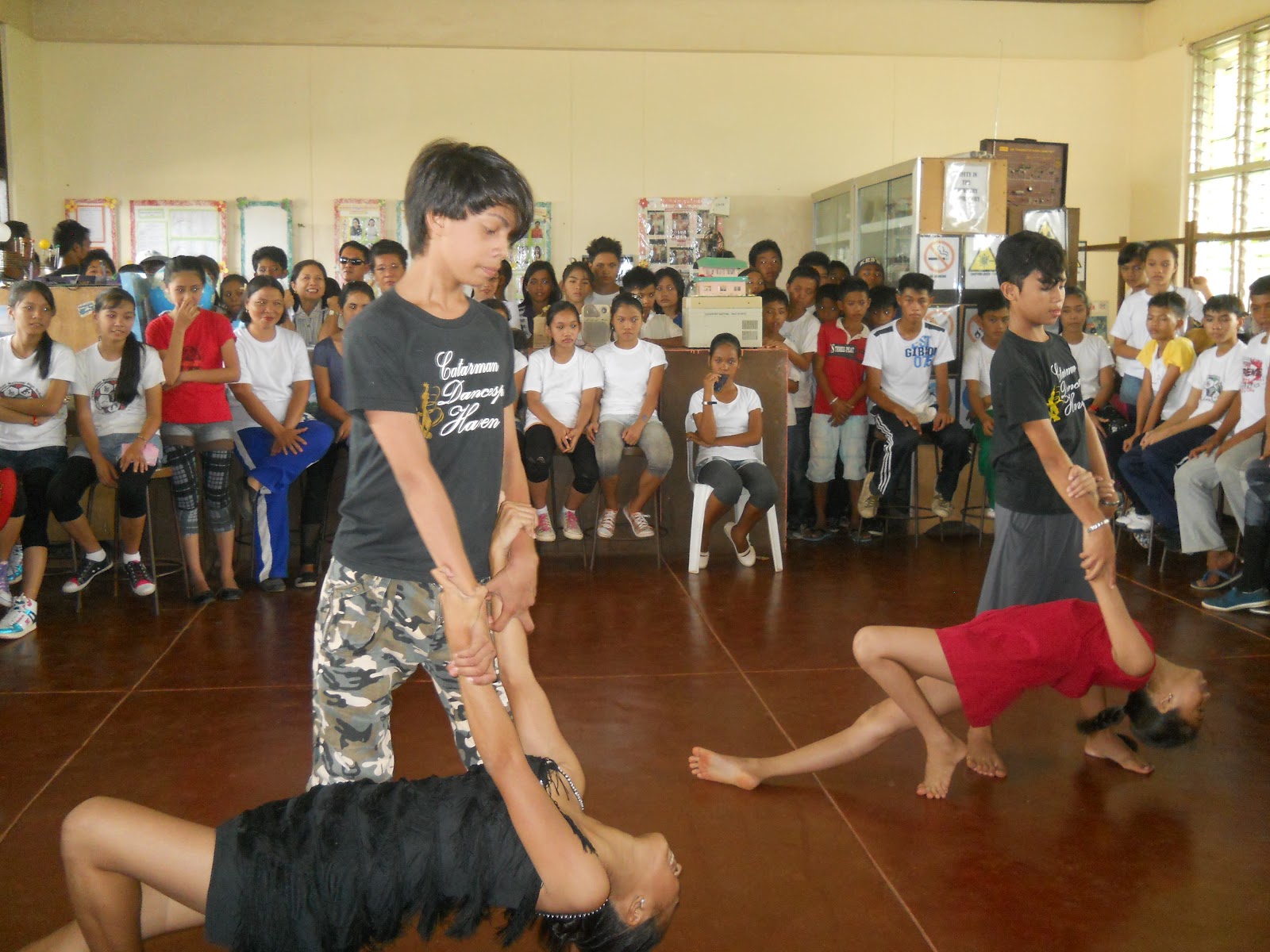
Our culminating performances in both Samar and at PHSA were some of my most memorable experiences from this trip. It surprised me how the act of performing really brings out the most in a person in the truest moments of their lives. What other kind of experience can replicate this? I was particularly proud of our last-minute planning to make an improvisatory dance score with our PHSA dance students in collaboration with the music students. As a PHSA student, I never performed to live music or was challenged to improvise to a piece that was made within a day! It was so thrilling to offer them such an experience.
As a former student of both PHSA and CCP years ago, I really wanted to share the broadness and joys of moving and exploring identities that I learned during my experiences in New York. I wanted them to fall in love with dance and I hope that I was able to influence and encourage them because they in turn have made me feel inspired to re-discover my love for dance during this process. Their pure motivations for learning and in pursuing what either interests them or what they love, without complications of income or status – things that I find usually hinder a contemporary artist – are truly inspiring. Teaching such limitless young minds and bodies also taught me the potential and unique individuality of the self in creating something of beauty and good. Outreach programs such as this are truly relative acts of giving and receiving. I love our team and what we were able to make in 4 weeks. There were definitely challenges, but how it all unfolded was something beautiful and profound…Let’s keep on doing this!

Sunday, August 5, 2012

Musician's Perspective: Week 2

by Brian Gnojek and Midori Samson

Week 2, Day 1 (June 11, 2012):
Teaching was a little difficult today at the Catarman SPED Center, because they were doing some kind of workshop at the main auditorium where we had taught last week. We were able to find an outdoor area to teach, and we taught a basic musical staff (only three lines), with each staff corresponding to a sound you could make with your body (clap, slap, stomp). By the end of the class, the students were reading basic music, and COMPOSING music by relating the high and low sounds to the cadence of words their teachers use: "Sit, down! Sit down!" "Pay attention, Pay attention," "Do you homework…" etc. We extremely impressed with the progress these students have made in essentially 3 days of class.


Day 2:
We spent today making musical instruments (shakers) out of plastic bottles, filled with sand, rice, and rocks, and decorated by them with colored pencils and pastels. One of our students wrote in her journal at the end of the day, "Today I learned that you can make a musical instrument out of anything!" :-)


Day 3:
Today we began planning for the end-of-the-week performance. Because the students do not have instruments besides their new shakers, we have decided we are going to sing and use our shakers and bodies to make the accompaniment. As it happened, at different points in the last week, we heard the SPED students singing "Somebody That I Used to Know" by Gotye, and the CNHS students sang "12:51" by the Philippine group Krissy and Ericka, so those are the songs we decided to perform. After assigning who would sing solos/duets (just a few lines of music per person), we began with some breathing exercises and vocal warm-ups to get the kids going, as well as some call and response to work on singing on-key.


The day ended with a brownout, but we got to see how beautiful the night sky was when there was no light pollution from the city. The team spent some quality time out on the back porch doing what we do best: goofing around and making each other laugh.


Day 4:
Today was the day we really started to put the music together for the performance. We used what they had learned about rhythms to write out accompaniment figures for the shakers, and for those that didn't have their shakers, we just did clapping and stomping feet, which was an important part of the music!


Day 5:
Today was the dress rehearsal at our performance space, the Catarman Municipal Auditorium. We ran everything a few times and did our best to get the students to SING OUT! By the end of the day, we felt pretty confident that the performance would go (relatively) smoothly. We were treated to a wonderful dinner by Marissa, the principal of CNHS, whose birthday was July 15. We (Midori and Brian) have been enjoying the food here, and this dinner was no exception: fish dip, flan, pancit, chicken wings, and a big birthday cake! We also had some mango salsa made by one of the only other Americans in Northern Samar, Lauren, who we were introduced to by our friend and part-time guide, Brenfred Romero. It was a really fun gathering, and reminded me that one of the best parts of this trip so far (and would prove to continue through the end of the trip) was the amazing people we met. Everyone was so friendly and helpful and supportive. Our jobs would have been extremely difficult if not impossible were it not for them.


Day 6:
The big day! The morning rehearsal went well, though it was a little tough keeping the kids in line with so much going on. The performance went very smoothly, and the students performed fantastically. The performance space was a large outdoor space and the town theater in Catarman. The stage was beautifully decorated with props donated by the teachers of CNHS and SPED including flowers, balloons, posters that the students created with our visual art teacher, Tighe, and a huge banner with a photograph of the governor of Northern Samar. It said that he, along with the mayor of Catarman supported Project Philippines and was decorated with the 4 words we incorporated into our lessons throughout the workshop: expression, trust, individuality, and respect. The amount of effort that both schools put into the performance day really showed us how much it meant to them that we were there. This was also made clear when we reflected on how much our students had grown in the last 2 weeks. We remembered how much they struggled to speak up during "Shabuya" in our first class. But during the performance, each student showed no hesitation to sing their solos loud and move with the music. We were extremely proud. Midori and Brian were also able to each do a solo, and we played the Poulenc Sonata as well, which was new (and I think a little confusing) to our Philippine audience, but very well received. After the concert was over, the team was treated like rockstars. Almost every student wanted their picture taken with us, our autograph, a "remembrance", or at least a hug. It was very touching, and many of the students had made us remembrances of their own. We ended the day with a well-earned night out with Brenfred, and Julius and Ray, who had helped us the entire 2 weeks with transportation, meals, and anything else we needed. Unfortunately, Midori had caught a Philippines cold with a high fever and had to stay home to get some rest. We all had to turn in fairly early because our flight out the next morning was at 6:30am.


Day 7:
Just a quick note to finish our trip to Northern Samar. We woke up at around 4:30am, packed our stuff and drove to the airport. We got out of the car only to find that several of the students from the Catarman National High School were waiting there to see us off! In addition, they sent us with a large piece of paper, about 4'x4', covered with notes and pictures and letters to us. It was a wonderful, beautiful gesture, and it is something we'll never forget. We were able to see them on the other side of the fence until our plane began takeoff. What a wonderful way to end the first two weeks of our trip.


Monday, July 23, 2012

Musician's Perspective: Week 1

Sorry for the lateness of our blog posts! Internet in the areas where we were teaching was sparse at best. We have also been so busy it’s been hard to find time to breathe! This post is written by Brian and Midori about their first week of teaching.

Week 1, Day 1 (June 5, 2012):
Flying went very, very smoothly, both the flight from Chicago to Hong Kong, and from Hong Kong to Manila. Who knew that the shortest path from Chicago to Hong Kong is through the North Pole? It’s always been my (Brian’s) dream to be met at a gate by someone with my name on a card, and it finally happened!

Day 2:
After 2 hours of sleep, we went back to the airport to fly to Northern Samar, our first stop on the trip. We got to watch a beautiful sunrise over the islands of the Philippines from the airplane, a real treat.

The airport at Catarman is the smallest I’ve ever been to, and some of the residents were on the runway to watch the airplanes land. The only gate area they had was made of lawn chairs and all that separated it from the security “checkpoint” (a guard who quickly looked through everyone’s bag) was a thin plexiglas wall. Very different from the US!

Runway side of the airport

Parking lot side of the airport
We got to the house, and it is gorgeous, right on the water. It’s hard to not feel guilty staying here when there is so much poverty surrounding us. It helped to remind ourselves of how much we’re going to help these kids. We were all very tired, so instead of teaching today day, we decided to go and just meet the kids. The kids at the Catarman SPED School were very polite and gracious, but there were a few more than we had planned on. We decided to split the 60+ kids into 2 groups to make teaching easier. These groups would alternate between music and dance classes during the next two weeks. The Catarman National High School was an experience: the students had prepared a whole dance sequence for us, and it was simply amazing. 


So much talent. Kendra, Leo and Chelsea are going to have a lot of fun teaching them! And we’ll have fun, too, because in my experience if you’re a good dancer, you have a pretty good musical foundation, too. After a great seafood dinner with Julius, one of our hosts (including what would become one of our favorite foods, pancit), we finally got a chance to sleep!


Day 3:
Today we taught an introduction game called "Shabuya", where you get in a circle, and everyone says their name and three things about themselves. The students were understandably shy at first, but we were able to get through the game with all groups at both schools. We also taught a game called "Zip, Zap, Zop" where you pass those three words around the circle and try to stay in rhythm (and say the right words!). We ended by playing part of the Beethoven Duet for clarinet and bassoon, and asked the students what they felt while we played. We emphasized that music (and all art!) is all about communicating a mood, idea, or story, and that you can change the way you play music according to how you want the listener to feel.

We ended this day with a performance at the Governor's Ball. In addition to the governor, the mayor of Catarman was there, and the contestants for the Miss Northern Samar 2012 pageant. It was a real treat, and great to eat freshly cooked pork carved off of a whole cooked pig! Midori and Brian performed a movement of the Poulenc duet for clarinet and bassoon, and a American folk-style piece that Brian arranged called "Till Dawn". Both were well-received.


Midori and Brian with Gov. Paul Daza
Day 4:

Today we visited the market to get supplies for the rest of our 2 weeks in Catarman. Grocery choices were limited, but we were able to get about 60 eggs for about $3, ingredients for chicken adobo, spaghetti, and some basics like bread and rice. The best part, though, was the fresh fruit: mangos, pineapple, and bananas! Like everything else at the market, the price of the fruit was unbeatable. We bought half a dozen mangoes for about $.60. Added to the fresh coconuts we were able to get near where we stayed, we were in produce heaven.


The music team continued teaching rhythms using the "Zip, Zap, Zop" game as a basis. The students grasped the concept of half, quarter, and eighth notes very quickly! We finished by playing an arrangement Brian did of Mark O'Connor's "Appalachia Waltz", another American folk-style tune reminiscent of Aaron Copland’s “Rodeo” and “Appalachian Spring.” As we played we asked the students to draw a picture as if we were the soundtrack to a movie. They came up with some very interesting ideas, from remembering a pet who had died, to wind blowing through hanging laundry in the summer. I hope to be able to scan some of the drawings and send them to the composer!


Day 5 and 6:
Midori and I woke up early to see if we could catch the sunrise over the ocean. It was beautiful.


The rest of the weekend was spent traveling all the way down the island, across a bridge to Leyte, finally settling in Palompon. On Sunday we went to a beautiful island near Palompon called Kalanggaman before traveling all the way back.

 
It was a long, winding, hilly drive, but we really got to see what the countryside in Samar is like, and it is beautiful.